Introductory essay · EntPhil@2 · EntPhil-v2.tex · 4a302292
The Philosophy of Enter: Destructive Readout, Quantum Recovery, and the Refusal of Identification
Ngo Cheung
Abstract
The Philosophy of Enter treats destructive computational-basis readout as an interface in which the measured quantum name is consumed and the observable output is a classical record, rather than a quantum system returned with the identity action on its code. A decoder belongs to a different interface: it is a quantum-return map from a declared accessible factor, and its target, retained references, observation boundary, and permitted operations must be stated before recovery can be claimed. Complete unitary preservation therefore does not imply recovery from a chosen subsystem, a channel does not specify a thermal machine, and this paper pairs these distinctions with named companion manuscripts while treating Born, Lüders, Landauer, no-hiding, Page, and Hawking as external accounts rather than premises of an Enter theorem. The resulting map licenses neither gravitational identification nor verification of an OpenAI family, and its standing stops are unchanged: XV-B is not opened, XVI-N is not discharged, O.1 stays NOT_CLOSED, no quantum coefficient of the inherited response is admitted, no compilation is asserted, and this is not spacetime emergence.
Introduction
The Philosophy of Enter begins with a restriction on what a mathematical interface allows us to say. Enter is destructive computational-basis readout. A quantum name is used by the operation and does not survive as an output name; the observable result is a classical record. This description concerns access and output type. It does not, by itself, describe the fate of every physical degree of freedom involved in an implementation. Nor does it identify the production of a record with the return of an unknown quantum state. The Enter Calculus Companion and its supplied Cheung manuscript records, including Manuscript I, version 2, present this discipline as a way of reading separate manuscripts without allowing shared vocabulary to carry conclusions between different models CheungManuscripts.
Four separations organize the argument. Destructive readout is not quantum recovery. A classical record is not a quantum-return decoder. A channel is not a thermal machine. An analog is not an identification. Each separation asks a practical question about a claim: what is the input, what is accessible, what is returned, and what additional construction would be needed for the proposed interpretation? These questions can be asked before adopting a position on measurement foundations or gravitational physics. Their purpose is to keep the stated conclusion attached to the operation that actually supports it.
The contribution is consequently a map, not a new theorem. Each philosophical sentence is paired with a manuscript that illustrates it and with an identification that the manuscript does not license. The registered sheets are documentary source records. Citing one does not make it a premise of another, and placing two records in the same paragraph does not construct a comparison map between their objects. Where a sheet proves a local result, that result remains inside its declared hypotheses. Where the supplied material is only a description or excerpt, this paper attributes the description rather than claiming an independent inspection of the complete proof.
The supplied OpenAI mathematics repository and catalogue materials form a separate source collection attributed to OpenAI OpenAISources. They include mathematical manuscripts and supporting artifacts at different reported stages of verification. Their documentary use here does not verify a family, import its hypotheses into an Enter manuscript, or turn the companion into a proof checker. The two grouped source entries are each cited once, at their substantive introduction; individual documents are identified thereafter by manuscript identifier, version, family number, or theorem label. Grouping is bibliographic only and implies neither shared hypotheses nor shared verification status.
The distinction matters especially when familiar physical language accompanies a finite construction. A factor may be called radiation, a region may be called a boundary, or a scheduled support set may be drawn on a cone. Those names can guide an analogy, but they do not establish a radiation history, a gravitational dictionary, or a derived spacetime metric. The missing identification may concern the state, dynamics, observable, access rule, or output space. Naming the intended destination does not supply that bridge. A refusal of identification is therefore not a refusal of the local result. It states what the result has established and leaves the further question visible.
The external literature provides useful comparisons without becoming part of the Enter proof programme. Born's probability account and Lüders's state-update rule distinguish outcome probabilities from the transformation associated with measurement Born,Luders. Landauer's account concerns the physical conditions of erasure, rather than the name of a reduced channel Landauer. The no-hiding theorem addresses the disposition of quantum information under its assumptions NoHiding. Page considers information in a radiation history, and Hawking supplies the semiclassical emission calculation used as an external input in the companion's comparison Page,Hawking. None is treated here as a theorem of Enter or as a substitute for a missing same-model construction.
This paper is not a derivation of the Born rule outside Manuscript I's stated class. It is not a general measurement theory, a black-hole thermodynamics paper, or a verification of any OpenAI family. Cheung's journal article is cited separately from the internal records; its supplied publisher record identifies an accepted article whose final formatted version is forthcoming CheungEnter. Internal manuscript dates and DOIs are not inferred from that publication. A further provenance limit concerns revisions: the outline described in the supplied manuscript requests VIII-A, VIII-B, and VIII-C version 3, while the supplied excerpts and registry identify version 2. The requested version-3 comparisons are retained below as outline-level descriptions, not as independently inspected revisions.
The five substantive sections that follow develop the two interfaces, separate the three ledgers, examine the analogs, retain the free-field and catalogue constraints, and close on the standing stops. Version-specific progress is recorded without turning it into permission to pass another gate. In particular, the historical H2 ending is distinguished from XIV-I's constructed I2 internal amplitude and from the still-missing joint maps at I3 and J2. Throughout, XV-B is not opened, XVI-N is not discharged, O.1 stays NOT_CLOSED, no inherited quantum coefficient is admitted, no compilation is asserted, and no spacetime-emergence claim is made.
The two interfaces
Destructive readout
Enter is destructive computational-basis readout. Its definition has two parts that should not be separated in interpretation: the measured quantum name is consumed, and the observable output is a classical record. Consumption refers to the declared interface. After the operation, the measured name is no longer available as the same quantum input to a continuation. The record, by contrast, can remain available for classical control or subsequent observation. This change in what is returned is the immediate reason that Enter should not be described as a decoder. Manuscript I supplies the local interface characterization.
Manuscript I, version 2, establishes Born uniqueness for destructive readout inside a stated class and identifies the corresponding projective residual rays within that characterization. The class and its compatibility requirements do real work. The result is not a record-free derivation, and it does not establish a field instrument merely because the word measurement appears in both settings. Born and Lüders remain external accounts of probability and projective update; their citation does not enlarge the class characterized in I Born,Luders.
The external instrument and quantum-operation literature provides a broader context for distinguishing outcome laws from conditional state changes. Davies and Lewis formulate an operational instrument framework, Kraus studies general state changes, and Ozawa treats measuring processes for continuous observables DaviesLewis,Kraus,Ozawa. These works are external frameworks with their own hypotheses. They are not sources for Manuscript I's particular uniqueness theorem and do not convert its destructive finite interface into a general field-measurement construction.
Record compatibility is not residual compatibility. Two operations can agree on the classical output being inspected without that agreement settling their complete surviving quantum outputs. A continuation that accesses those outputs asks a different question from a comparison of record distributions alone. The distinction is not repaired by calling both comparisons measurement compatibility. The object being compared must remain explicit. In I, the uniqueness statement holds inside the declared class; it does not transfer residual compatibility to a setting that has supplied only a record-level condition.
The resource language has an equally narrow meaning. I's global live-qubit budget counts the live qubits of its complete configurations. A scheduled laboratory peak may use another accounting convention, including separate treatment of incoming systems and external references. Neither count can replace the other without an explicit comparison. A bound proved for the global calculus is not automatically a limit on the simultaneous storage of a laboratory device. The distinction protects both statements: the calculus retains its precise resource hypothesis, and an implementation must state what its own ledger charges.
Manuscript VII-E, version 1, locates the observation boundary through spectator, record, residual-instrument, and continuation criteria, together with one four-face certificate. The boundary specifies what a comparison is permitted to observe and continue with. It is not a physical light cone. Likewise, the four-face certificate is a result for its named construction, not a general measurement theorem. If a decoder later returns a quantum output and that output is observed, the observation is another measurement. It is not the identity action on the code that a recovery claim would require.
The decoder as a different interface
A decoder is a quantum-return map from a declared accessible factor to a quantum output. Its definition concerns both access and target. One must say which part of the complete output the decoder can act on, what quantum information it is intended to return, and whether correctness includes correlations with untouched references. These declarations cannot be recovered from the word decoder alone. A classical answer to one question and the return of an unknown quantum state are different tasks, even when both are produced from the same accessible factor. Stinespring's dilation theorem and Choi's finite-matrix characterization supply external mathematical background for completely positive maps; neither specifies the physical access contract of a particular decoder Stinespring,Choi.
Manuscript Oai280-C, version 1, certifies one declared decoder on one declared accessible interface. The information target may be a whole code, a subsystem, or a finite algebra. These targets are not interchangeable. Whole-code recovery asks for the logical quantum state to be returned, including its reference correlations. Subsystem recovery leaves other degrees of freedom outside the requested task. Recovery of a finite algebra can be narrower still. A certificate has to follow the target that was fixed before the measurements were chosen, rather than a stronger target introduced after a favourable record was obtained. The external operator-algebraic theory of error correction similarly makes the recoverable observable structure explicit, without supplying Oai280-C's implemented-channel certificate BenyObservables.
A constant complete complement is a full-code criterion. It should not be silently imposed as the criterion for every subsystem or algebraic task, nor should success on one effect be presented as a test of the whole identity channel. The external error-correction and information–disturbance literature provides the appropriate context for these distinctions, but the companion's certificate retains its own complete tested channel and validation contract KnillLaflamme,KSW. The philosophical point is that the requested output determines the strength of the claim.
Oai280-C also supplies a finite-sample restriction: forty shots cannot accept the 0.1 threshold under its stated Hoeffding procedure. This is a limitation of that procedure and contract, not a universal statement about every possible statistical test. Hoeffding's inequality concerns bounded observations under its assumptions; using it does not establish those assumptions for a laboratory Hoeffding. The certificate's shot count is therefore not a calibration of a physical apparatus. Nor does certification of the declared decoder construct a gravitational dictionary.
Manuscript VII-G, version 1, supplies a finite completely positive trace-preserving hybrid instrument, with branchwise observation closure and spectator-blind histories. In its example, a population-only observation algebra does not reveal every phase change in the surviving matter. A continuation that measures coherence must declare a larger observation boundary. This prevents coherence from being treated as both inaccessible and available when convenient. The instrument is not gravitational dynamics, and a spectator-blind history is not physical annihilation. Its value here is to show how a complete instrument can preserve a precise observation contract without collapsing that contract into a claim about everything outside it.
The payoff
The central sentence now has a definite meaning: complete unitary preservation does not imply recovery from a chosen subsystem. A reversible complete evolution can retain the input information somewhere in its joint output while a particular accessible factor fails to support the required decoder. The missing step is not the preservation of the whole output. It is the existence of a return map with the stated access restriction and information target. Oai280-C makes that restriction part of the certificate rather than leaving it to the interpretation of a diagram.
Quantum recovery is also not destructive classical observation. A record can report a named outcome accurately without returning the coherence or reference correlations of the unknown input. Later preparation of a quantum system from that record does not, merely by having a quantum output, establish recovery of the original state. The task must still be checked at the channel level. Manuscripts I, VII-G, and Oai280-C retain these distinct output and access questions. This is why the distinction between a classical record and a quantum-return decoder cannot be reduced to a difference in terminology.
Figure fig:two-interfaces contrasts the returned outputs and access conditions of destructive readout and quantum recovery.
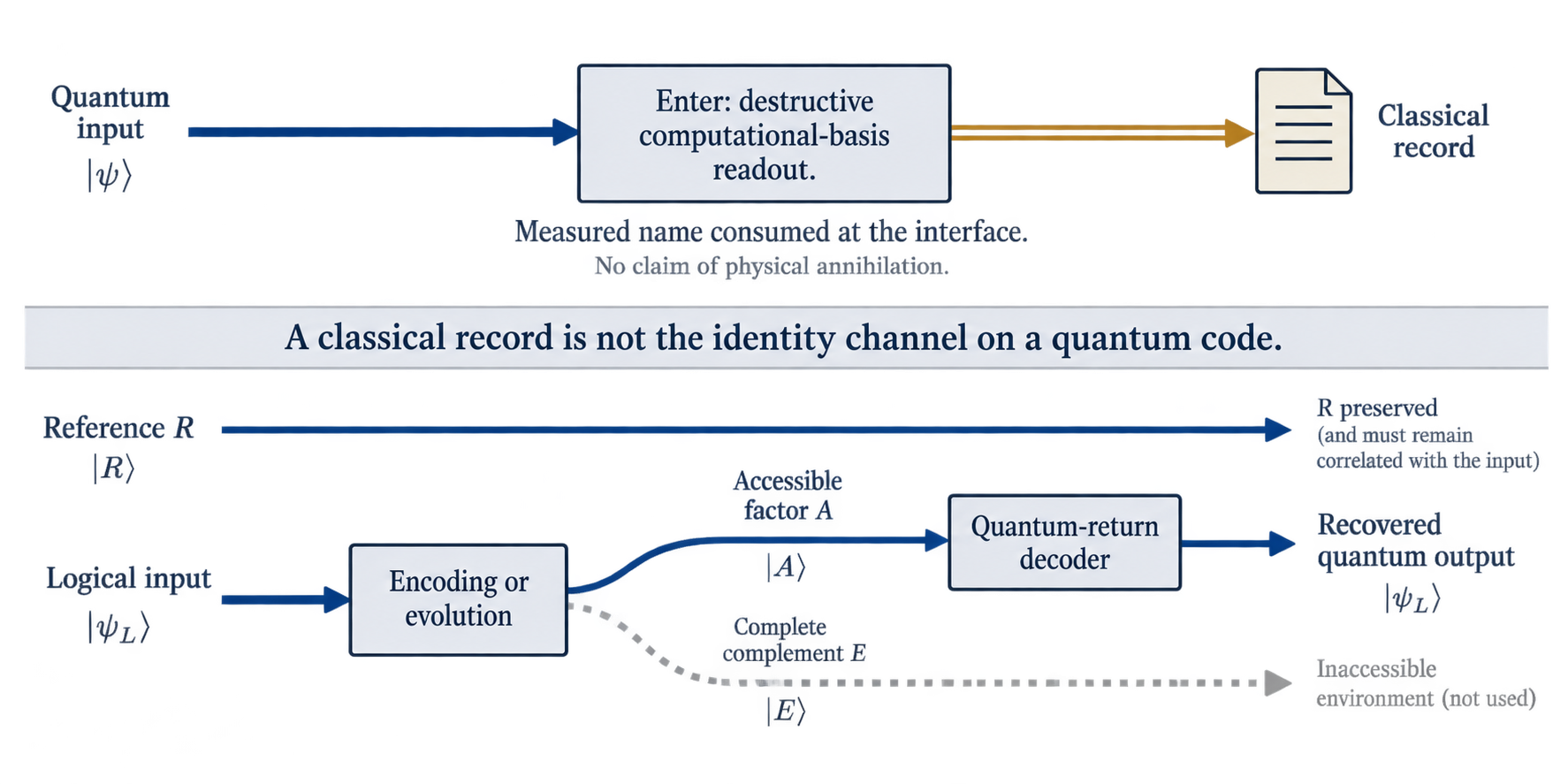
Two different interfaces: destructive readout and quantum recovery. Enter consumes the measured quantum name at its declared interface and returns a classical record; this does not assert physical annihilation of its implementation's degrees of freedom. A decoder instead acts on a declared accessible factor and returns a quantum output. Whole-code recovery must preserve correlations with untouched references. Agreement on a classical record does not establish the identity channel on the quantum code.
The payoff
Readout followed by discard is partial trace on the surviving interface, including untouched references. Keeping the references in that statement prevents an agreement of selected marginal statistics from being mistaken for a complete-channel identity. Yet this channel equality is not a proof of physical annihilation. Discard describes which factor is no longer returned or accessible in the model. It does not specify a mechanism that destroys all physical carriers of the information, an apparatus reset, or the energy exchanged during implementation. En07-C, version 1, records the complete-channel comparison without making those further identifications.
Finite-program termination has the same kind of limit. A programme can reach its last instruction while a physical interpretation still lacks an evaporation endpoint, a complete outgoing interface, or a model of what remains. Ending the schedule is a property of the declared computation. It is not evidence that a black hole has completed a physical process. At this point the paper has separated the interfaces only. It has not yet opened the energy, erasure, or leakage ledgers, and it has not supplied the same-model obligations needed to identify a finite endpoint with a gravitational one. En07-B and En07-C retain those obligations.
Three ledgers, not one channel
The three ledgers
The companion distinguishes complete energy, erasure cost, and residual leakage. They are three ledgers because they answer different questions. Complete energy concerns the systems and controls included in the energy account. Erasure cost concerns a specified physical reset or standardization process. Residual leakage concerns the dependence of inaccessible output on the input. A reduced channel can be relevant to each account, but it does not contain all three accounts merely by being a channel. En07-B and En07-C preserve these separate questions.
In particular, equality between readout-and-discard and partial trace does not fix heat, work, or reset cost. It does not derive . Landauer's account remains external: it concerns physical memory and the conditions under which its logically irreversible operation is implemented Landauer. To apply such an account, one must specify the memory, bath, preparation, and control. The Philosophy of Enter does not deny that erasure can have a thermodynamic cost. It denies that the cost has been discharged by a statement that identifies only an input–output channel. External treatments by Sagawa and Ueda and by Reeb and Wolf make thermodynamic assumptions and reservoir properties explicit; their results apply to those specified setups rather than to a channel name alone SagawaUeda,ReebWolf.
Reversible uncomputation belongs to another interface again. The complete restore map acts on the joint output and recycles a coherent computation when the required registers remain available. Bennett's reversible-computation account is a useful external comparison because the restoration keeps the input rather than deleting it Bennett. In En07-C's channel account, complete restoration is not a radiation-only decoder and does not erase an unknown input. The distinction is between undoing an available joint computation and recovering from a factor after access to the other factors has been removed.
The three ledgers therefore prevent a familiar shortcut. Information may be preserved globally, a register may be reset, and an accessible channel may be nearly independent of its input; none of these statements can substitute for the others. Each must identify the systems to which it applies. This is bookkeeping with consequences: an omitted residual can change the recovery question, while an omitted bath or control can leave the proposed erasure account unspecified.
Figure fig:three-ledgers separates the energy, erasure, and leakage accounts and identifies the additional specifications each requires.
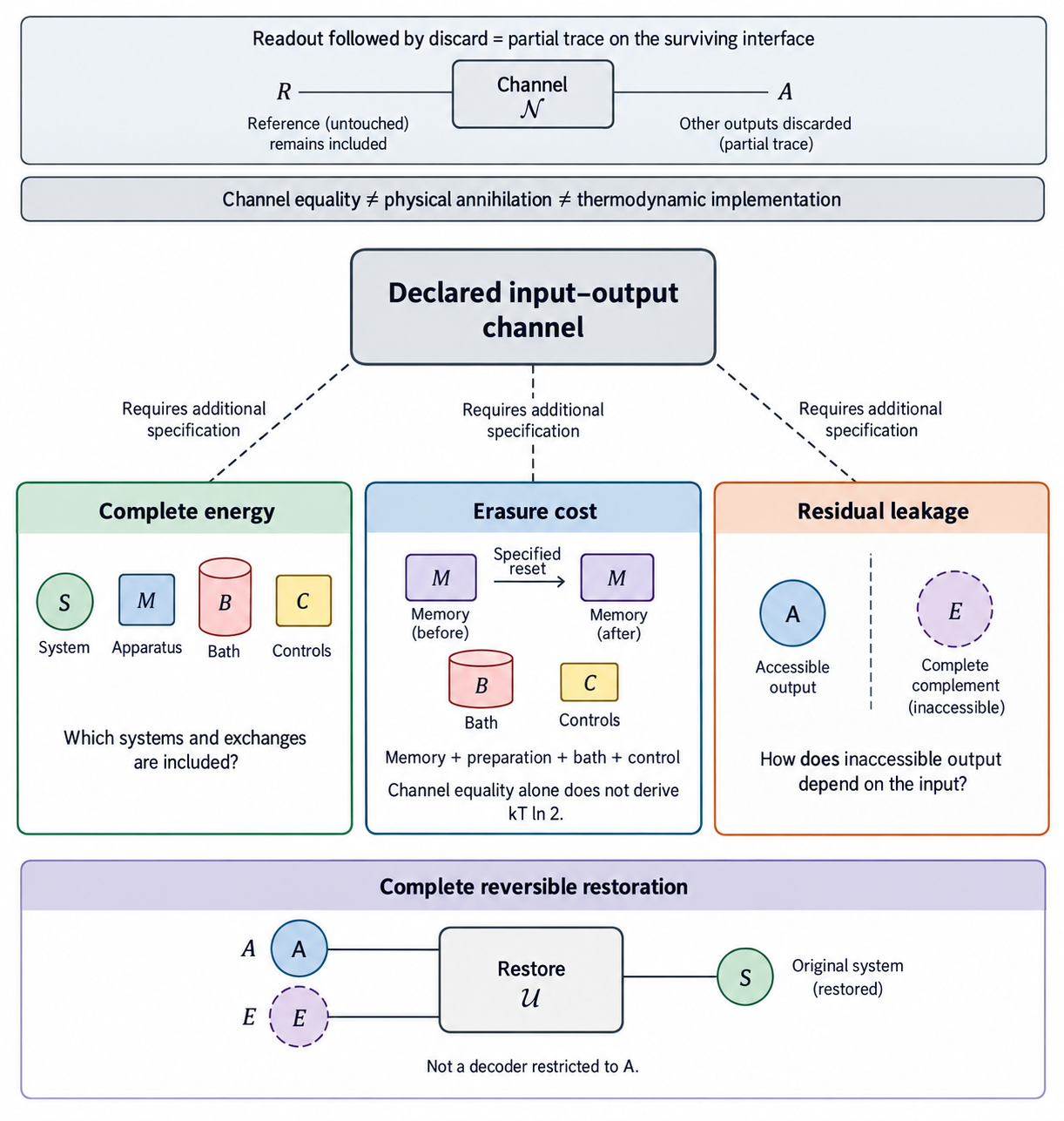
Three ledgers, not one channel. Complete energy, erasure cost, and residual leakage concern different systems and questions. Equality between readout-and-discard and partial trace on the surviving interface, including untouched references, does not specify a physical reset, determine heat or work, or derive . Complete reversible restoration requires access to the relevant joint output; it is neither erasure of an unknown input nor recovery restricted to one accessible factor. Dashed connections indicate additional specification, not implications supplied by the channel alone.
Complement constancy and the two directions
Manuscript En07-B, version 1 in the supplied registry, states a finite-interface endpoint certificate under destructive Enter. Exact complement constancy, half-diamond information–disturbance bounds, and the remaining endpoint obligations are conditional statements about its declared model. The four same-model obligations are not constructed by the certificate. Its use of endpoint language consequently does not identify the finite result with a gravitational endpoint. The philosophical task is to preserve the conditional structure, not to turn a list of requirements into a claim that those requirements have already been met.
Two directions of comparison must remain separate. A nearly constant complete complement bounds recovery error from above: it supports a conclusion that an appropriate recovery can be accurate under the stated hypotheses. A nearly constant accessible output bounds recovery error from below: input dependence has become difficult or impossible to retrieve through that access interface. Exchanging the two factors changes the meaning of the conclusion. The information–disturbance literature supplies an external setting for the relationship, but it does not authorize importing constants or reversing inequalities between differently normalized claims KSW. Bény and Oreshkov provide a related external environment-side formulation of approximate correction using worst-case entanglement fidelity; that metric and its constants are not silently identified with En07-B's half-diamond convention BenyOreshkov.
The word complete is essential. A retained residual register is not necessarily the entire complement. Other omitted outputs, loss systems, and a purification required by the model can matter to its input dependence. Constancy of one selected residual does not establish constancy of everything outside the decoder's access. Conversely, finding input dependence in the complete complement obstructs exact whole-code recovery without requiring that the residual be an independent copy of the code. The criterion concerns a channel, not a visual assignment of information to one object. En07-B and Oai280-C retain this distinction.
Manuscript Oai290-A, version 1 in the supplied registry, separates whole-code recovery from a named observable and from a modular-band witness. A nonconstant complete complement blocks exact recovery of the whole code, but it need not block the recovery of one effect. The smaller task may survive even when the larger task fails. A modular-band witness is a further typed object, not an automatic substitute for either task. Family 290-02 is not verified by this assembly, and the finite decision is not bulk reconstruction. The target and the witness must remain distinct from the geometric interpretation being withheld.
Manuscript Oai069-A supplies the receiver-only example described in the outline reproduced by the supplied manuscript. Its programme returns a named label and a qubit multiplicity. Removing a coefficient leg gives a sharp all-decoder error while leaving a named effect recoverable. No numerical value absent from the supplied description is inferred here. The torus benchmark is not a specialization of Family 069, and the stated DG equivalence is not an AdS dual. This source is used at summary level, with no supplied version identifier or full text and no entry in the supplied registry excerpt, to illustrate why a successful observable task cannot be expanded into an unreported whole-code or gravitational result.
Figure fig:recovery-contract organizes the recovery claim by access, information target, and execution resources; the streaming benchmark is discussed in Section 4.6.
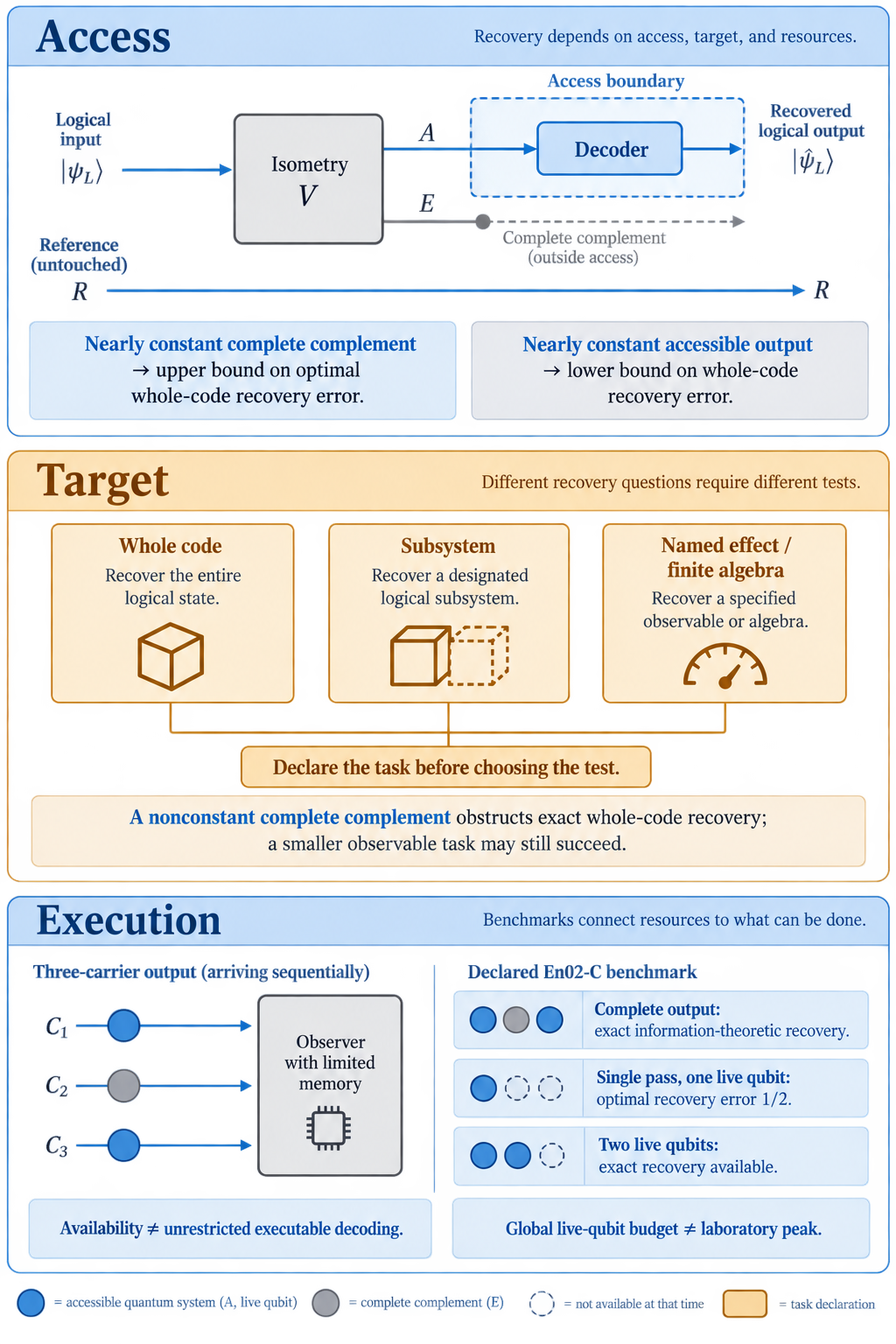
Recovery depends on access, target, and execution resources. Under the stated whole-code hypotheses, near constancy of the complete complement supports an upper bound on optimal recovery error, whereas near constancy of the accessible output supports a lower bound. Whole-code, subsystem, and named-observable tasks are distinct targets. In the declared En02-C benchmark, the complete three-carrier output permits exact recovery, but the single-pass one-live-qubit observer has optimal recovery error ; two live qubits permit exact recovery. These benchmark statements do not identify the global live-qubit budget with a laboratory peak.
External spectra and static records
Manuscript En07-C compares Hawking's 1975 thermal emission with the destructive Enter interface. Hawking's spectrum is an external semiclassical input Hawking. The comparison does not derive that spectrum from the finite calculus. Nor does it make the spectrum itself a replacement channel. A frequency occupation statement concerns specified observables in a field calculation; a replacement channel is an input–output statement about the dependence of an entire accessible output on its input. The two require different data.
For the same reason, the external spectrum is not a verdict on the complete complement. Selected thermal occupations do not specify every correlation, every unobserved mode, or every input-dependent output in a proposed evaporation model. The comparison must retain those gaps rather than filling them with the word thermal. En07-C does not construct an evaporation channel, and its endpoint statement remains conditional on the same-model obligations that it does not supply. This is an evidential boundary, not a universal claim that thermal observations can never belong to a recoverable process.
Hayden and Preskill provide a distinct external information-retrieval model with assumptions about unitary, rapidly mixing dynamics and the retriever's control over emitted radiation HaydenPreskill. Those assumptions illustrate why a recovery scenario requires more than an occupation law. They are not supplied by En07-C's spectrum comparison and are not premises of an Enter endpoint certificate.
Manuscript Oai265-A, version 1, records a static area-law separation. Its worked example shows that two complete isometries can have the same selected zero accessible entropy and disagree on recovery. The entropy agreement is therefore insufficient to identify the accessible channel's recovery properties. The record concerns a static construction, not a time-indexed radiation process. Family 265 is not verified, and the static record is neither reference-preserving recovery nor a radiation history.
The distinction also limits the significance of a dimension count. Counting an available Hilbert-space dimension can constrain a finite construction, but it does not by itself supply an area law or identify a graph cut with a gravitational horizon. Oai265-A keeps the channel, temporal, and geometric interfaces separate. Its documentary use in this paper does not convert the catalogue's spatial claim into a theorem about information carried by outgoing radiation.
No Page curve is constructed. Page's account concerns information in black-hole radiation under its own assumptions about the complete process Page. It remains an external entropy-history hypothesis here, not a consequence of the channel ledger. The absence of a history is not remedied by choosing an entropy value at one point or by presenting a static area-law record. Section 4 returns to this non-identification without treating the missing history as a new objection to the local finite results.
Analogs, not identifications
No-hiding and exact correction
The companion's sentence is precise when its scope is retained: in the declared whole-code channel setting, the accessible factor recovers the code exactly only when the complete complement is constant. This concerns all code inputs and the appropriate reference-preserving task. It is not a claim about a selected marginal or one prepared state. The external no-hiding account and the theory of exact quantum error correction provide related distinctions, but their assumptions should not be merged into an unnamed universal statement NoHiding,KnillLaflamme.
A nonconstant residual need not be an independent copy of that code. Input dependence can obstruct exact recovery without furnishing a second freely available logical system. Calling the residual informative says less than calling it a copy, and neither claim can be settled by inspecting one entropy value. En07-B and Oai280-C retain the complete complement for precisely this reason. The criterion is operational: what information task can be reversed through the accessible interface, and what dependence remains outside it?
Manuscript Oai280-B, version 1, supplies a finite example. In its printed five-qubit construction, privacy holds for every boundary set of at most two qubits, while accessible decoders exist for every set of at least three qubits. Both the small-set privacy claim and the larger-set recovery claim refer to the same declared encoding. This makes the access distinction concrete without requiring a gravitational interpretation. A certificate for the connected implemented channel remains a certificate for that channel.
The forbidden identification is equally concrete. A single pentagon is not an extended geometry and is not spacetime. Its usefulness as a finite code diagram does not supply a metric, a field theory, or a gravitational duality. The external analogy can help a reader recognize the recovery structure, but it cannot turn the code's drawing into the physical object suggested by the drawing. The finite result is preserved by refusing that additional claim, not diminished by it.
Holographic reconstruction
A holographic dictionary would have to be justified separately. Naming one factor boundary and another bulk does not add a metric or identify their observables with those of a gravitational theory. A Hilbert-space dimension count is not an area law. The proposed relationship needs a declared correspondence, with the relevant domains, states, and access conditions. These requirements are not supplied by the resemblance between a finite recovery diagram and a familiar picture of reconstruction.
External AdS/CFT and holographic relative-entropy frameworks specify substantially more structure than the names of two factors. Maldacena's large- proposal concerns particular field-theory and gravitational limits, while the relation studied by Jafferis, Lewkowycz, Maldacena, and Suh concerns nearby states and a stated order in the bulk gravitational coupling Maldacena,JLMS. These are external models and comparisons; they do not furnish a dictionary for the companion's finite benchmark.
Manuscript XVII-A, version 1, reconstructs one bounded sine effect at the central bulk point from one declared boundary time interval in a finite-matrix AdS2 benchmark. It also gives an exact binary record channel for that effect. The AdS2 setting is assumed in the benchmark; it is not derived from the record. The conclusion concerns the named bounded effect, rather than every bulk observable or the identity channel of an unspecified bulk code. Keeping the effect and the record explicit prevents the reconstruction statement from changing its information target.
The local lemma labelled lem:timeband is especially important to the reading. In the finite model, every nonempty open time interval is algebraically complete. The supplied proof description uses finitely many analytic frequencies and finite matrices to isolate the required generators. That is a finite-cutoff algebra statement. It does not identify a boundary tensor factor with a spacetime subregion, establish locality of the regulated bulk field, or provide a resource and conditioning estimate for the inversion.
Accordingly, lem:timeband is not an entanglement wedge. The result is not metric reconstruction, not Einstein dynamics, not holographic emergence, not a Page curve, and not an island. Each denied identification would require a different conclusion from the one bounded-effect reconstruction actually supplies. An exact binary record can establish the specified measurement task while leaving all of those further questions open. Exactness does not remove the need to say what is exact.
The registered XVII-A is also not replaced by an ultraviolet draft merely because that draft cites it. Citation preserves a documentary relationship; it does not establish that a later construction has the same observable, representation, or cutoff. Any proposed extension has to retain or explicitly compare the original benchmark before borrowing its conclusion. This is a general discipline illustrated by XVII-A: a local reconstruction should be read through its declared correspondence, not through the larger physical programme that its terminology may evoke.
The Page curve
A Page curve is an entropy history of radiation under its own hypotheses. Its temporal character is part of the claim, not an optional interpretation added to a static entropy calculation. Page's external account concerns information in a complete formation-and-evaporation setting Page. This paper neither supplies that setting nor infers it from a finite record.
Oai265-A is the worked refusal. As Section 3 established, the sheet separates a static area-law record from reference-preserving recovery and from a radiation history. The additional point here is the non-identification: selected zero radiation entropy does not become a Page curve by being assigned a radiation label. Nor does that selected value identify a recovery map. The local construction lacks the temporal interface needed for the historical claim, and the Philosophy of Enter does not add it.
This refusal does not prohibit comparison with entropy histories constructed elsewhere. It requires the comparison to specify the evolving radiation system, the complete state and access rule, and the hypotheses under which the entropy is evaluated. Penington's external evaporating AdS/CFT analysis, for example, introduces absorbing boundary conditions and a quantum extremal-surface transition rather than inferring a history from one static entropy value Penington. That framework is not instantiated by Oai265-A. Until a correspondence is supplied, the analog remains an analog. No Page curve is derived from the channel ledger, and no curve is constructed in this manuscript. The static example remains useful because it makes one unsupported inference visible without pretending to decide every radiation model.
Apparatus reset
An apparatus reset returns a declared memory factor to a declared state. That description does not imply that a record already delivered to an untouched register has been rewritten. The output interface can contain both the reset memory and a surviving record elsewhere. Treating the state of the first factor as the state of the entire experiment would remove part of the very interface needed to describe what the experiment has reported.
VII-E's spectator and residual-instrument criteria provide the local example. Spectator-blind control is a condition on the compared executions: equal declared accessible inputs and equal control data select the same rules, checks, certificates, and name transport. Adding inaccessible spectator names does not change those selections. This is not a statement that spectators cease to exist or that their histories have been erased. Their storage and required transport history remain separately reserved.
Reset must therefore be read alongside the record and continuation criteria. If a later operation accesses a register that was previously outside the observation boundary, the continuation needs to declare that access. If it does not access the register, the absence of observation is not a proof of annihilation. The section makes no claim that the residual is physically annihilated and no thermodynamic claim about the reset cost. It identifies the narrower operation that has actually been described: restoration of one memory state within a larger retained interface.
Finite causal transport
Manuscript VII-J, version 1, proves that scheduled ancestors bound actual influence in its finite architectures. A scheduled path can exist without a surviving signal, so scheduled ancestry is an upper bound rather than a universal equality. The complete network matters: records, branch sums, and untouched references cannot be replaced by a selectively normalized branch when establishing the stated influence claim. The theorem is about the declared operational network, not every possible process suggested by its graph.
Exact physical containment holds once the edges are causally embedded. That embedding is an additional certificate, and the operational speed is an input. The schedule does not derive an invariant physical speed or a spacetime metric. A continuum-field successor would need a field algebra and state, an encoding of admitted observables, a target evolution, a discretization comparison, and a detector model. VII-J supplies no such successor by analogy. Certified matter communication on a fixed cone is not matter-driven evolution of the cone.
External algebraic and locally covariant quantum field theories specify observable algebras together with locality or spacetime-covariance structures. The Haag–Kastler and Brunetti–Fredenhagen–Verch frameworks illustrate the additional mathematical data involved HaagKastler,BFV. They are not supplied by a finite schedule, and their citation does not establish that VII-J has a field-theoretic scaling limit.
The outline's version-3 description of VIII-A concerns a fixed-presentation matching packet. A matching packet is not Einstein dynamics. Its version-3 description of VIII-B concerns a sourced interval; a promised token is not a measurement. Its version-3 description of VIII-C concerns a guarded schedule; scheduled support is not a light cone. These requested descriptions are retained at their supplied level. The available version-2 excerpts and registry entries are not silently relabelled version 3, and no uninspected revision is presented as an independently checked proof.
The outline reports that the comparisons used in those sheets are proved locally. That is a statement about the described sheets, not permission to transfer a theorem between their models. In the supplied VIII-B excerpt, calling a fixed Hermitian matrix a current is distinguished from defining its expectation, using that expectation in a source rule, and proving the admitted geometric family. The interpretation is not itself a premise of the geometric proof. Likewise, supplying a token for a finite table does not establish operational acquisition of its value.
The supplementary relationship record makes a further refusal explicit. The Wick-product track is not the sourced deficit current. Retarded coefficients, sharp harmonic insertions, and a numerical finite-part prescription are not thereby VIII-B's represented source or an acquired classical token. The missing route would pass through representation, a named source boundary, and acquisition. VIII-A through VIII-C do not construct it. Shared domain discipline does not resolve another track's interacting-product problem, and none of these finite transport comparisons constitutes a field theory or spacetime emergence.
Figure fig:analogs-identifications summarizes four local constructions and the stronger interpretations that require separately justified identifications.
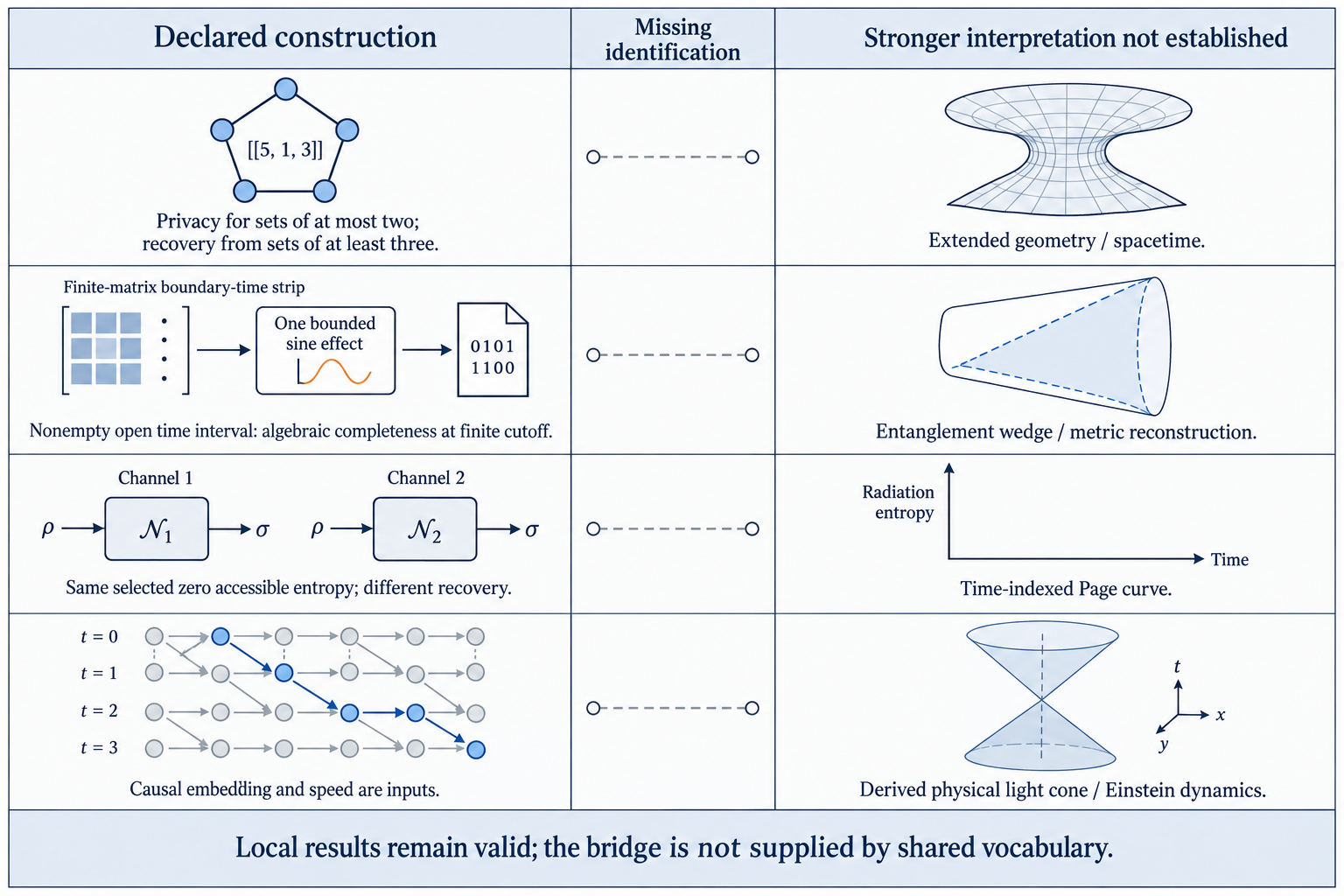
Analogs are not identifications. Four declared constructions are contrasted with stronger interpretations they do not establish: a finite five-qubit code is not extended geometry; finite-cutoff reconstruction of a bounded effect is not an entanglement wedge or metric reconstruction; a static entropy record is not a Page curve; and scheduled influence is not a derived physical light cone or Einstein dynamics. The gaps mark unconstructed correspondences, not universal impossibility results. Refusing these identifications leaves the stated local results intact.
Streaming recovery
Streaming recovery separates information-theoretic availability from executable decoding. Information can be present in an accessible output while a programme with a specified memory limit cannot return it at the requested accuracy. Availability, existence of a recovery channel, and execution of that channel are therefore different questions. A positive answer to the first does not automatically answer the third. This is the interface counterpart of the paper's broader distinction between a channel and an implementation.
The supplied En02-C benchmark makes the separation quantitative. Its complete three-carrier output permits exact information-theoretic recovery. Under the declared single-pass, one-live-qubit observer model, the optimal recovery error is one half; with two live qubits, exact recovery is available. The one-live-qubit value optimizes over the permitted decoder class rather than merely reporting failure of one chosen circuit. It is still a theorem about that finite benchmark and its delivery and memory rules, not an unrestricted resource optimum for Enter.
The execution panel of Figure fig:recovery-contract summarizes this benchmark without extending it to other delivery or memory rules.
Manuscript I supplies the local accounting counterpart. Its global live-qubit budget and a decoder's laboratory peak are not interchangeable. The same channel can have different resource costs under different legal schedules, and a schedule must say when inputs arrive, which names remain live, and how returned outputs and references are charged. These declarations belong to the execution claim rather than to the abstract existence of a decoder.
External memory lower bounds are similarly tied to a computational task and model. Nayak's bounds concern quantum automata and random access codes, not En02-C's particular recovery programme Nayak. They provide context for the importance of a declared memory contract, not an independent proof of the one-live-qubit error stated here.
Nothing in this subsection converts the bound into a device specification. It supplies no hardware bandwidth, storage lifetime, laboratory calibration, or universal optimum over all implementations. Nor is the finite radiation benchmark a Page curve, an entanglement wedge, or a derivation of evaporation dynamics. The useful analog is narrower: available quantum information does not determine the resources of a particular observer. The manuscript keeps that distinction operational by naming the observer's permitted programme instead of treating access as an unlimited ability to decode.
Free-field and catalogue constraints
The free-field and catalogue sheets prevent two further readings of the Philosophy of Enter. A finite interface discipline is not already a field theory, and a catalogue record is not already a verification. The two limits are related only at the level of reading practice. In each case, the construction or source must be identified before its vocabulary is expanded into a stronger conclusion. Neither a familiar field-theoretic name nor a formalization note can fill an absent model or proof obligation.
Manuscript VII-H, version 1, constructs one connected vacuum susceptibility of a free massless scalar and classifies its contact ambiguity. The benchmark keeps the free equation, field normalization, Minkowski vacuum, calibrated source and readout, and source sign fixed. Changes of vacuum, mass, or source normalization are not merely alternative names for the same comparison. The contact freedom concerns the declared coincident response convention. If calibration fixes that convention more tightly, the admissible class becomes smaller without changing the meaning of the benchmark's stated invariant experiment.
That susceptibility is not an ultraviolet completion. It is not VII-D's reflected triangle and not the inherited gravitational characteristic coefficient. These exclusions keep distinct objects distinct: a constructed free response, a numerical distributional prescription in another track, and an unadmitted gravitational coefficient do not become one quantity through the word response. VII-H can be a precise positive example while leaving the separate characteristic-product programme untouched. Its complete ambiguity classification concerns its own benchmark, not every contact freedom in the companion.
Manuscript VII-I, version 1, constructs a finite-width density-prepared free algebra and proves that the original sharp dressing is not admitted off shell in its stated setting. A repair must say which preparation datum or equality requirement it changes. The resulting finite-width algebra is not the original sharp interacting observable. The supplied source also distinguishes agreement with the old product from continuous sharp extraction; those conditions cannot simply be demanded together where the stated incompatibility applies. No interacting quantum differential, gravitational Ward identity, or inherited retarded quantum coefficient is supplied by this free construction.
External constructions of local Wick polynomials and causal perturbation theory likewise state their locality, covariance, and extension conditions explicitly. Hollands and Wald and Epstein and Glaser provide relevant mathematical context for why admission and renormalization require a declared domain and prescription HollandsWald,EpsteinGlaser. Their constructions do not establish that the companion's sharp observable satisfies those conditions or repair its specific obstruction.
Oai282-A, Oai282-B, and the Family 282 catalogue record concern the local Ward question. Oai282-B, version 1, constructs the improvement scalar and local conformal currents for one free massless scalar. Its two probes cover the declared homogeneous stress class, not unrestricted tensors. Finite vanishing acquires its stated force because coverage is proved inside that class. Without that restriction, a finite family can miss a nonzero conserved perturbation. The number of probes is therefore meaningful only together with the space they are proved to cover. Callan, Coleman, and Jackiw provide an external historical treatment of improved energy-momentum tensors and associated scale and conformal currents, not a verification of Oai282-B's local Ward theorem or Family 282 CCJ.
Conservation of a conformal-Killing current is not, by itself, a Ward identity on every field. Oai282-B's stronger free local action must be read with its own domain and algebra, rather than inferred from conservation alone. A traceless improvement is not Einstein dynamics, and the improvement scalar is not the inherited gravitational characteristic coefficient. Family 282 is not verified by the companion comparison. The catalogue reports no Lean scope note for that family. This absence is a documentary limit, not a theorem that a formalization is impossible.
Oai280-A, version 1, records Family 280's conditional correspondence from simple unitary strongly rational vertex operator algebras to completely rational conformal nets. The hypotheses remain part of the correspondence. Its documentary presence does not supply a gravitational metric, a Page curve, or spacetime. The Lean scope note names one file, VertexAlgebraNet.lean, for 280-01 only. It does not extend its named scope to every paper in Family 280, and neither the note nor the companion's sector-label comparison is presented as verification of the family.
The external conformal-net analysis of Kawahigashi, Longo, and Müger illustrates how representation-theoretic conclusions depend on stated net and subfactor hypotheses KLM. It supplies context for the mathematical meaning of complete rationality and modular representation structure, not a proof of the reported Family 280 correspondence and not a gravitational identification.
The OpenAI catalogue is itself a source record. In the supplied catalogue account reproduced by this manuscript, Lean scope notes for 242 families name 341 preprints. Those numbers are retained as reported snapshot counts, not as the result of an independent recount or proof audit. A note names the linked preprints, not every paper in the family. The searchable catalogue sheet is versioned 7 October 2026; its provenance does not establish the correctness of each mathematical claim it records. A scope note is not a verification and is not spacetime emergence.
These limits also prevent a change of authorship or evidential status by proximity. The catalogue attributes its external manuscripts to OpenAI; the companion's comparisons are documentary records by Cheung. Citing both does not make the companion a verifier of the catalogue. This paper verifies no family, including 265, 280, 282, 290, 211, or 069. The value of the catalogue paragraph is modest but necessary: it identifies what the source says about scope while refusing to turn a report of formalization into an unexamined certificate.
Figure fig:free-field-catalogue distinguishes constructions within declared free-field classes from documentary catalogue records and formalization scope notes.
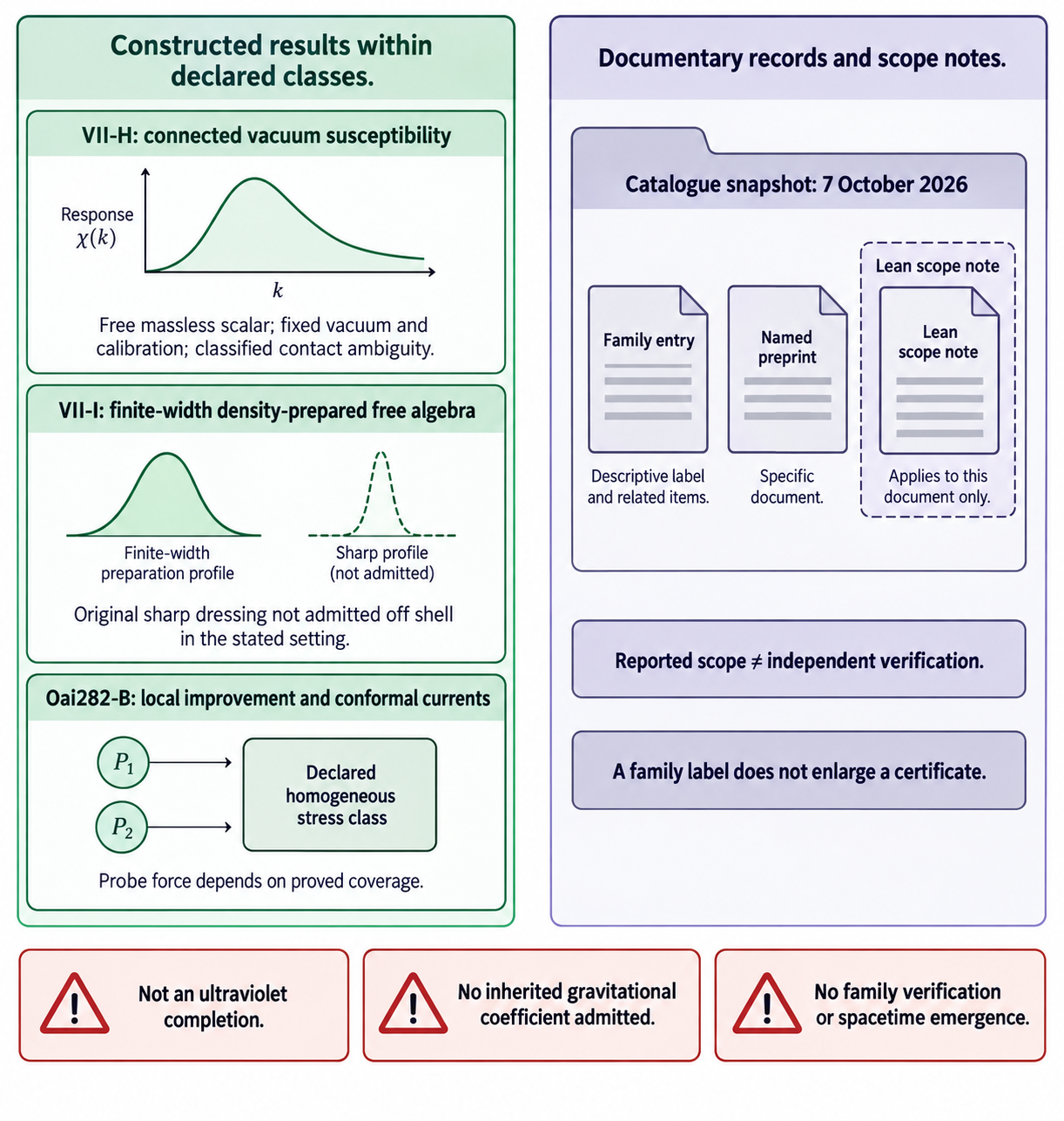
Two distinct evidential tracks. The left column summarizes reported constructions within declared free-field settings: a connected vacuum susceptibility, a finite-width density-prepared algebra, and local improvement and conformal currents with probe coverage restricted to the stated stress class. The right column distinguishes catalogue entries, named preprints, and formalization scope notes in the reported 7 October 2026 snapshot. A scope note does not independently verify a preprint or its entire family. Neither track supplies an ultraviolet completion, admits the inherited gravitational coefficient, or establishes spacetime emergence.
The standing stops
Manuscript Em02-E identifies one classical relational lapse on an explicit power-law Einstein–scalar background. The background is an input, and the classical identification does not complete the quantum regulator-removal audit. Quantum covariance, state, counterterm class, remainder, and gauge identity are not constructed. The supplied source keeps ultraviolet and spatial cutoffs separate; convergence at fixed radius does not establish their joint limit. Its classical kernel bridge is not a quantum contraction or a renormalized graph. There is no asserted limit toward . This is not a de Sitter state, not quantum gravity on that background, and not spacetime emergence. The incomplete audit is also not promoted to a universal nonexistence theorem.
Manuscript XVI-N's Theorem 11 covers one massless special family. In the supplied revision r12, the obstruction is conditional on Route A, and Route B is not discharged. Arbitrary prescribed positive mass remains unresolved; the certified small-mass interval is not the arbitrary-mass statement. The result is therefore not a universal completion, and the prepared theory is not a Batalin–Vilkovisky, or BV, complex. Calling the question a completion problem does not construct the missing complex or enlarge the family covered by the theorem. XVI-N is not discharged by the interface distinctions in this paper, and no independent repair of its insertion programme is inferred.
Manuscript XVI-O records a kernel counterterm under a stated prescription. Acceptance depends on the fixed extension, the identity on its named domain, the active reference, and the required moment formulae. These conditions do not amount to bulk BV restoration or completion of the prepared insertion. The supplied o70-sync record keeps the broader spanning question partial and keeps the kernel two-point subsector distinct from the bulk symmetry problem. A counterterm available in that subsector does not settle every counterterm or identity required elsewhere. O.1 stays NOT_CLOSED; the interface philosophy neither supplies the missing restoration nor changes the frozen insertion's status.
Manuscript XVI-P records a renormalized kappa-squared two-point sector with QdS external legs. The sector is an external-leg scheme, not a de Sitter state, and not closure of O.1. The supplied p23 record must also be read with its correction: the p19 claim of failed counterterm closure was retracted as a Grassmann-orientation bookkeeping error, and the corrected relative factor is . The source reports local closure for the complete declared one-loop kappa-squared counterterm within the named ghost-plus-one sectors, not bulk symmetry restoration. This local advance should not be erased by repeating an older failure, but it should not be enlarged into the closure that the record expressly withholds. No independent computational rerun is claimed here.
Manuscript XV-B, version 2 as specified in the outline and supplied registry, proves relative lifting, a jet-null criterion, closed-set extension, and a one-point puncture correction. The supplied older comparison excerpts identify version 1; the requested version-2 description is accordingly cited at outline and registry-description level rather than as a newly inspected full text. In either documentary role, existence of the technical manuscript is not the opening of its downstream use. XV-B is not opened by any certificate in this paper. Its exit requires the stated admission, not a finite observation certificate, a free-field benchmark, a source token, or a partial off-characteristic reference.
The standing labels H2, I3, and J2 retain their recorded unresolved scope, with one necessary qualification: XIV-H's version-1 H2 verdict is a predecessor ending, whereas XIV-I constructs the named internal amplitude gate at I2. That progress does not construct the full joint characteristic map at I3. XIV-J supplies reconstruction descent and a supported-sector reference away from the characteristic locus, not the full map across it. Its conditional extension interface chooses no extension coefficients. No joint section, uniform transverse estimates, complete contact compatibility, or required output wavefront theorem for the inherited coefficient follows from those partial results. The remaining analytic chain is therefore still a chain of obligations, not a programme executed by this article. No quantum coefficient of the inherited response is admitted, no differential is applied to an absent coefficient, and no compilation is asserted. These stops mark missing constructions in their stated classes; they do not prove that every possible future construction must fail.
Figure fig:standing-stops records local advances alongside the distinct obligations they do not discharge; its parallel tracks do not assert a single dependency chain.
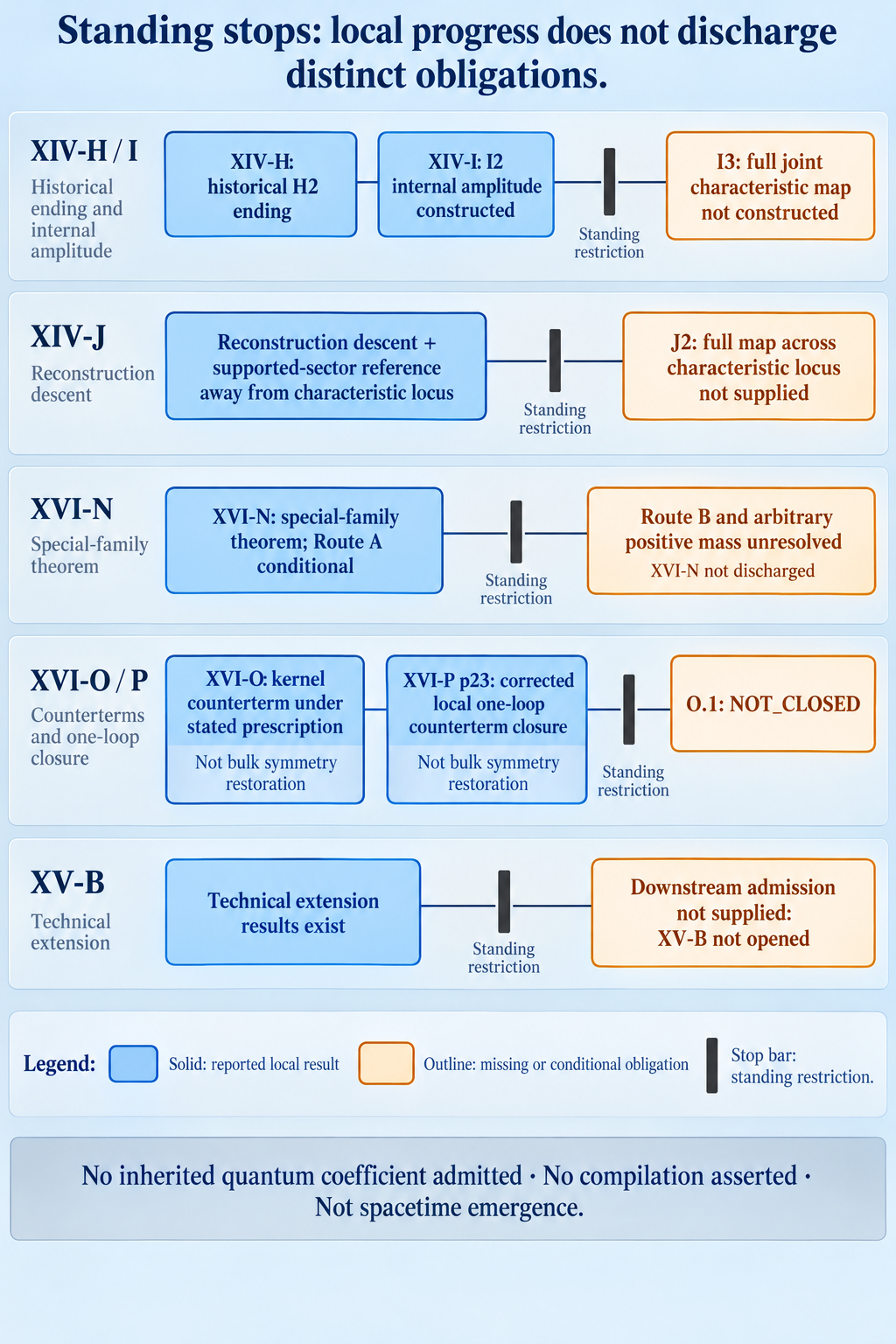
Standing stops and version-specific local progress. XIV-I's constructed I2 internal amplitude is distinguished from XIV-H's historical H2 ending and the missing full joint maps at I3 and J2. XVI-N retains its stated route and mass restrictions. XVI-O's kernel counterterm and XVI-P's corrected local counterterm closure do not provide bulk symmetry restoration or close O.1. XV-B's technical results do not open its downstream use. Parallel tracks indicate distinct obligations, not a universal dependency chain or a nonexistence theorem. No inherited quantum coefficient is admitted, no compilation is asserted, and no spacetime-emergence claim follows.
Conclusion
The Philosophy of Enter contributes a map of claims and boundaries. Each philosophical sentence has been paired with the manuscript that illustrates it and the identification that the manuscript does not permit. The paper adds no measurement theorem, gravitational dictionary, evaporation endpoint, or emergence result. Its contribution is to make the scope of an existing construction readable without allowing an attractive interpretation to replace the missing comparison.
The four separations remain intact. Destructive readout is not quantum recovery. A classical record is not a quantum-return decoder. A channel is not a thermal machine. An analog is not an identification. These are not interchangeable warnings. The first two concern the information task and returned output. The third concerns the physical implementation and its energy or erasure account. The fourth concerns the bridge from a declared model to the object proposed as its interpretation. Keeping them separate allows a finite certificate to retain its exact force without acquiring a conclusion it has not proved.
The examples show that this discipline is compatible with positive local results. A decoder can be certified, an observation algebra can close branchwise, a bounded effect can be reconstructed, a finite transport target can be realized, and a free local Ward action can be constructed. None of these achievements has to be weakened to avoid overstatement. What must be withheld is the unconstructed identification: a quantum identity from a classical record, a heat cost from partial trace, a Page curve from a static entropy value, a light cone from a schedule, or spacetime from a code diagram. The external accounts remain valuable comparisons, but they do not become premises of an Enter theorem through citation.
The standing stops are unchanged: XV-B is not opened, XVI-N and Route B are not discharged, O.1 stays NOT_CLOSED, the version-specific H2, I3, and J2 boundaries retain their recorded qualifications, no quantum coefficient of the inherited response is admitted, no compilation is asserted, and this is not spacetime emergence. Acknowledging XIV-I's internal advance or XVI-P's corrected local counterterm closure does not pass the distinct obligations that remain. The paper's final discipline is thus neither scepticism about every construction nor confidence borrowed from shared names. It is the requirement that a conclusion stay attached to its object, domain, access rule, and evidence. The sheets remain source records, the analogs remain analogs, and the philosophy does not discharge the obligations it names.
Bibliographic provenance. The supplied Cheung source records and the supplied OpenAI source records are grouped separately and each group is cited once at its first substantive introduction. Individual documents are identified thereafter in prose. The journal article and external literature retain separate entries, ordered by first citation; reference numbers are generated by LaTeX. DOIs reproduce supplied bibliographic metadata or bibliographic source records consulted for the additional external references. No DOI or publication date has been invented for an internal manuscript or an unavailable family document. Version discrepancies, outline-only descriptions, and reported formalization scopes remain explicit. Bibliographic grouping does not imply common hypotheses, proof transfer, or verified claims. These references and schematic figures do not assert independent proof inspection, machine verification, software execution, laboratory calibration, or successful LaTeX compilation.
References
CheungManuscripts
Cheung, N. (n.d.).
Enter Calculus Companion and referenced supplied Cheung manuscript records.
https://enter.grok.me/
This grouped entry identifies documentary materials attributed to Ngo Cheung. No publication date or DOI is supplied for the internal manuscripts, and none is inferred from the separately listed journal article. Manuscript identifiers are retained rather than reconstructing unavailable formal titles. Registered descriptions, supplied excerpts, and outline-only descriptions are distinguished below. Reported analytical constructions are not presented as independently inspected proofs, machine-checked results, executed programs, laboratory calibrations, or compiled sources. Grouping does not make one constituent a premise of another.
Enter Calculus Companion. Registered-manuscript index and documentary source interface; no date or version identifier supplied for the interface itself. It separates the registered Cheung manuscripts from the OpenAI catalogue, and describes itself as a searchable companion rather than a proof checker.
Manuscript I.
I.tex, version 2; registered description and supplied excerpts. Itsthm:maincharacterizes Born probabilities and destructive projective residual rays inside the stated class. It is not record-free uniqueness or an independence theorem for the five requirements. Record compatibility, residual instruments, global live-qubit budgets, and scheduled laboratory peaks remain distinct. No compilation, mechanized proof, or independent execution is asserted.Manuscript VII-D.
VII-D.tex, version 1; registered description used for the reflected-triangle comparison. It reports a strong distributional finite part of one numerical reflection-triangle family with an explicit real counterterm class. This is a subtraction prescription, not an algebra construction, and it does not remove the predecessor continuity obstruction. No compilation is asserted.Manuscript VII-E.
VII-E.tex, version 1; registered description and supplied excerpts. It specifies the destructive-readout observation boundary and spectator, record, residual-instrument, and continuation criteria, with one four-face adjacency certificate on a fixed cone. It proves no field equation or distributional finite part. No compilation is asserted.Manuscript VII-G.
VII-G.tex, version 1; registered description and supplied excerpts. It specifies a finite completely positive trace-preserving hybrid channel with branchwise observation closure and spectator-blind histories. Informative classical records, exact whole-input recovery, and residual access are distinguished. Its energy statement is an operator identity, not physical energy conservation; gravitational dynamics and the field-theoretic source remain unresolved. No compilation or independent execution is asserted.Manuscript VII-H.
VII-H.tex, version 1; registered description and supplied excerpts. It constructs a connected free massless-scalar vacuum susceptibility on four-dimensional Minkowski space and classifies its stated contact ambiguity. It is not VII-D's reflected triangle, an interacting gravitational response, or the inherited characteristic coefficient. No compilation or independent execution is asserted.Manuscript VII-I.
VII-I.tex, version 1; registered description and supplied excerpts. It reports a finite-width density-prepared free polynomial algebra, exclusion of the original sharp off-shell dressing, changed transmission data in the ramp limit, and a stated incompatibility of sharp-admission and continuity requirements. It does not construct the original sharp nonlinear interacting observable or an interacting quantum BRST algebra. No inherited gravitational quantum coefficient, compilation, or independent execution is asserted.Manuscript VII-J.
VII-J.tex, version 1; registered description and supplied excerpts. It separates scheduled reachability, operational influence, and an independently supplied physical causal relation. Its cone application uses a prescribed metric and certified embeddings; it does not derive a metric, Lorentz invariance, gravitational dynamics, or an invariant physical speed. No compilation or independent execution is asserted.Manuscript VIII-A.
VIII-A-v2.tex, version 2 in the supplied registry and excerpts. It defines a fixed-presentation affine matching interface and distinguishes stale-deficit seam failure from failure of pointwise worldline fixation under a time shift. No sourced backreaction law or compilation is asserted. Version 3 is requested in the outline reproduced byEntPhil-v1.tex, but its full text is not supplied; that requested revision is used only at description level.Manuscript VIII-B.
VIII-B-v2.tex, version 2 in the supplied registry and excerpts. It constructs a deterministic sourced conical packet on a compact deficit interval and persistence of the declared cellulation. Its finite table implements a promised token rather than acquiring an expectation or implementing the continuum nonlinear law. No mixed incidence-deficit germ or compilation is asserted. The outline's requested version 3 is not silently substituted for the supplied version 2.Manuscript VIII-C.
VIII-C-v2.tex, version 2 in the supplied registry and excerpts. It composes fixed-packet flow, guarded incidence, and promised source-table replacement under inherited interface hypotheses. The source token is supplied, not acquired; schedule support is not identified with a light cone. No mixed incidence-source germ, polygon Hamiltonian, or compilation is asserted. The requested version-3 account remains description-level material.Supplementary relationship description. Unnamed description reproduced in
EntPhil-v1.tex; no separate title, date, version, or full text supplied. It distinguishes the Wick-product track from the sourced-deficit current and leaves representation, source-boundary identification, and acquisition unconstructed. It is not treated as an independently verified manuscript.Manuscript En02-C.
En02-C-v1.tex, version 1; registered description and supplied excerpts. Its finite sequential radiation benchmark permits exact recovery from the third radiation prefix, has optimal single-pass one-live-qubit error , and admits an exact two-live-qubit decoder. Laboratory occupancy and external radiation storage are separate. It is not an old-black-hole model, an unrestricted Enter resource optimum, a Page curve, or an evaporation derivation. No compilation or execution record is claimed.Manuscript En07-B.
En07-B.tex, version 1 in the supplied registry; the older outline did not supply a version identifier. It gives a half-diamond endpoint certificate conditional on four unconstructed same-model obligations. Near constancy of the complete complement gives a recovery upper bound; near constancy of the accessible output gives a recovery lower bound. It constructs no gravitational endpoint and asserts no compilation or independent execution.Manuscript En07-C.
En07-C.tex, version 1; registered documentary comparison. It compares the finite complete-complement and destructive-readout interfaces with Hawking's external semiclassical occupation law. Thermal data, energy drain, termination, and outgoing recovery remain separate. It constructs no gravitational evaporation channel and asserts no compilation or independent execution.Manuscript Oai069-A. Summary-level documentary description reproduced in the supplied
EntPhil-v1.tex; no version identifier or full text supplied, and no entry appears in the supplied registry excerpt. The description concerns a receiver-only label and multiplicity programme, an omitted coefficient leg, and a named-effect comparison. No missing numerical value, Family 069 specialization, or AdS identification is inferred.Manuscript Oai265-A.
Oai265-A.tex, version 1; registered documentary comparison. It separates a static lattice area-law record, reference-preserving recovery, and a gravitational entropy prescription. Its two complete-isometry example has identical selected zero accessible entropy and different recovery properties. It does not verify Family 265, construct an area law from a dimension count, or provide a Page curve. No compilation or independent execution is asserted.Manuscript Oai280-A.
Oai280-A.tex, version 1; registered documentary comparison. It records Family 280-01 Theorem 1.1 and Corollary 9.3 as source claims and supplies a sector-label and finite-channel separation. A sector tag is not sector identification, and a Q-system is not a gravitational dictionary. Family 280 and its named Lean scope are not independently verified. No compilation or laboratory calibration is claimed.Manuscript Oai280-B.
Oai280-B.tex, version 1; registered documentary comparison. It prints a five-qubit encoding, proves privacy for every set of at most two shares, constructs ideal decoders for every set of at least three shares, and states a finite-confidence implemented-channel certificate. A single pentagon is not extended geometry. It verifies neither Family 280 nor a gravitational dictionary and asserts no compilation or laboratory calibration.Manuscript Oai280-C.
Oai280-C.tex, version 1; registered documentary comparison. It freezes the information target, accessible channel, complete tested channel, and validation contract before measurements are selected. Whole-code, subsystem, finite-algebra, and named-effect recovery remain distinct; forty shots cannot accept the 0.1 threshold under its stated Hoeffding procedure. It is not an entanglement wedge, a gravitational dictionary, or verification of an OpenAI family. No compilation or laboratory calibration is claimed.Manuscript Oai282-A.
Oai282-A.tex, version 1; registered documentary comparison. It records Family 282-01 as a source claim and supplies a finite local-Ward certificate with an independently required coverage condition. Conservation, local Ward action, global integration, and Einstein dynamics are distinct. It does not verify Family 282 or construct the joint characteristic map. No compilation or independent execution is asserted.Manuscript Oai282-B.
Oai282-B.tex, version 1; registered documentary comparison. It reports a complete local conformal Ward action for a free massless scalar on four-dimensional Minkowski space, an improvement scalar in the original Weyl net, and two-probe coverage of a declared homogeneous class. The probes do not cover unrestricted conserved tensors, and local Lie brackets do not establish global integration or Einstein dynamics. Family 282 is not verified; no compilation or independent execution is asserted.Manuscript Oai290-A.
Oai290-A.tex, version 1 in the supplied registry; the older outline did not supply a version identifier. It separates full-code recovery, named-effect reconstruction, a modular-band witness, and a specified-decoder certificate. It locally restates a witness associated with a supplied 23 September 2026 preprint without verifying that paper. Family 290-02 is not verified or instantiated as bulk reconstruction. No compilation or laboratory calibration is claimed.Manuscript Em02-E.
Em02-E-v1.tex, version 1; registered description and supplied excerpts. It identifies a classical relational lapse on an explicit power-law Einstein–scalar background and separates spatial-tail and ultraviolet-limit questions. Its quantum outcome is an incomplete audit, with no constructed covariance, state, admissible counterterm class, remainder, or Ward identity. There is no limit toward , de Sitter-state identification, or quantum admission. No compilation is asserted.Manuscript XIV-H.
XIV-H.tex, version 1; registered description and supplied excerpts. It supplies source incidence, named internal kernel maps, and regular symbol charts but ends at unresolved H2 for the uniform internal amplitude. This is a predecessor ending, not a claim that XIV-I makes no progress. No quantum coefficient or compilation is asserted.Manuscript XIV-I.
XIV-I.tex, version 1; registered description and supplied excerpts. It constructs the named I2 internal amplitude, retarded-pole module, annular estimates, and reconstruction of the two K5 placements with a lower-degree remainder. It does not construct the joint characteristic operator map at I3. No quantum coefficient or compilation is asserted.Manuscript XIV-J.
XIV-J.tex, version 1; registered description and supplied excerpts. It distinguishes amplitude presentation degree from an intrinsic joint symbol and gives an off-characteristic supported-sector normal-jet reference. Its conditional extension interface is not an extension prescription; the full map remains unresolved at J2. No quantum coefficient or compilation is asserted.Manuscript XV-B.
XV-B.tex, version 2 in the supplied registry and requested outline. Older supplied comparison excerpts identify version 1. Version 2 is the technical continuation, not the downstream admission exit, and reports lifting, contact, jet-null, extension, and one-point correction results. It does not instantiate the six-branch contraction or construct the inherited full map. The version-2 account is used at supplied-description level, not as newly inspected full text; XV-B is not opened, and no quantum coefficient or compilation is asserted.Manuscript XVI-N.
XVI-N.tex, revision r12; registered description and supplied excerpts. It reports the corrected prepared root current, analytic nonvanishing for one massless special family, and Theorem 11's conditional obstruction for one regular seed-preserving antifield-linear completion of that instance. The certified interval is ; arbitrary prescribed positive mass and the universal insertion statement remain unresolved. Route B is not discharged, the prepared theory is not a BV complex, and no compilation or symbolic execution is claimed.Manuscript XVI-O.
XVI-O.tex, revision o70-sync; registered description and supplied excerpts. It records a finite massless scalar matter-loop kernel on the invariant baseline, not the prepared action. The classical kappa-squared master and spanning gate remain partial; the kernel two-point Ward identity is not bulk ST4b or BV restoration. O.1 remainsNOT_CLOSED. Archived scripts are package evidence, not certificates, and no compilation is asserted.Manuscript XVI-P.
XVI-P.tex, revision p23; registered description and supplied excerpts. It records one-loop power counting and a renormalized kappa-squared two-point sector with QdS external legs. The p19 closure-failure claim is retracted; the corrected projected counterterm is closed only in the named ghost-plus-one sectors, not as bulk symmetry restoration. QdS is an external-leg scheme, not a de Sitter state. O.1 is not closed, and certificates and archives are package evidence rather than a series certificate. No compilation is asserted.Manuscript XVII-A.
XVII-A.tex, version 1; registered description and supplied excerpts. It reconstructs one bounded sine effect and binary record channel on an assumed global AdS2 finite model. Itslem:timebandis a finite-cutoff algebraic identity, not an entanglement wedge. The radius and coordinates are inputs; no metric reconstruction, Einstein dynamics, holographic emergence, Page curve, or island is constructed. No compilation or independent execution is asserted.
OpenAISources
OpenAI. (2026).
Referenced supplied OpenAI mathematics repository and catalogue records.
https://github.com/openai/math
This entry groups the OpenAI-attributed materials actually discussed in the manuscript. It preserves the distinction between the supplied repository README, catalogue descriptions mediated by the companion, named family records, and reported formalization scopes. It is not an independent audit of the repository or its proofs, and no current repository state is inferred beyond the supplied snapshots.
Repository README and collection description. The supplied
openai/mathpage describes mathematical manuscripts and supporting proof artifacts produced by an internal OpenAI model. It reports 719 manuscripts in 372 families and approximately 42% of top-line results formalized. It explicitly states that verification stages differ, not all results have Lean formalizations, and some unformalized results may have issues. Individual manuscript citations and build instructions belong to their own directories. These repository-level statements are not certificates for the Cheung series.OpenAI mathematics catalogue. The companion's searchable source-record wrapper is
OpenAI.tex, version2026-10-07, describing the catalogue of 6 October 2026 with the history update of 7 October 2026. Its underlying catalogue manuscripts are attributed to OpenAI; the wrapper is not an independently verified OpenAI proof artifact. It reports 719 manuscripts in 372 families and about 300 formalized top-line results. It also records three withdrawn titles: Weil classes on split abelian eightfolds, Kuga–Satake correspondences for K3 surfaces, and The rational Hodge conjecture for products of K3 surfaces. Withdrawn titles are not treated as current results.Reported formalization-scope counts. The supplied
EntPhil-v1.texreproduces a catalogue account in which scope notes for 242 families name 341 preprints. These are retained as reported snapshot counts; no independent recount is asserted. A scope note names the specified preprint or file, not every member of its family and not a theorem of the Cheung series.Family 265. Catalogue entry referenced through the supplied companion record; no separate date or version identifier supplied. It concerns the static area-law record discussed in Oai265-A, not a radiation history or reference-preserving recovery certificate. The supplied
Canonical265.leandescription concerns moment canonicalization, not an area-law formalization. Neither the family nor that file is independently verified here.Family 280, especially 280-01. Catalogue entry referenced through the supplied companion record; no separate publication date or revision identifier supplied. The recorded source claims include Theorem 1.1's conditional VOA–net correspondence and Corollary 9.3's extension claim. The reported Lean scope names
VertexAlgebraNet.leanfor 280-01 only. No extension of that scope to the entire family, independent verification, or gravitational identification is asserted.Family 282, especially 282-01. Catalogue entry referenced through the supplied companion record; no separate date or version identifier supplied. It is recorded as a source claim about a local traceless improvement and local Ward identities, not a global conformal action or Einstein dynamics. The supplied catalogue account reports no Lean scope note. The family is not verified by Oai282-A, Oai282-B, or this manuscript.
Family 290, especially 290-02. Catalogue record discussed through Oai290-A; the supplied summary associates its modular-band witness with a 23 September 2026 preprint. The reported Lean note names 290-02 only, not 290-01. Neither preprint is independently verified or instantiated as bulk reconstruction here.
Family 211. Catalogue record discussed only as an external mathematical comparison. The supplied companion account keeps the Fortuin–Kasteleyn continuum-random-tree specialization conditional. A path average, Hausdorff-dimension statement, or tree record is not a recovery channel or a derived surface manifold. No verification is asserted.
Family 069. Named only in the summary-level Oai069-A comparison reproduced by
EntPhil-v1.tex. No underlying Family 069 manuscript, formal title, date, version, or proof text is supplied for this comparison. The torus benchmark and stated DG equivalence are not treated as a verified Family 069 specialization or an AdS dual.
The supplied OpenAI catalogue is not a premise of a registered Cheung sheet. Its grouping here does not close O.1, discharge Route B or XVI-N, open XV-B, admit the inherited quantum coefficient, or construct spacetime emergence.
Born
Born, M. (1926).
Zur Quantenmechanik der Stoßvorgänge.
Zeitschrift für Physik, 37, 863–867.
https://doi.org/10.1007/BF01397477
Luders
Lüders, G. (2006).
Concerning the state-change due to the measurement process
(K. A. Kirkpatrick, Trans.).
Annalen der Physik, 15(9), 663–670.
https://doi.org/10.1002/andp.200610207
(Original work published 1951)
Landauer
Landauer, R. (1961).
Irreversibility and heat generation in the computing process.
IBM Journal of Research and Development, 5(3), 183–191.
https://doi.org/10.1147/rd.53.0183
NoHiding
Braunstein, S. L., & Pati, A. K. (2007).
Quantum information cannot be completely hidden in correlations:
Implications for the black-hole information paradox.
Physical Review Letters, 98(8), Article 080502.
https://doi.org/10.1103/PhysRevLett.98.080502
Page
Page, D. N. (1993).
Information in black hole radiation.
Physical Review Letters, 71(23), 3743–3746.
https://doi.org/10.1103/PhysRevLett.71.3743
Hawking
Hawking, S. W. (1975).
Particle creation by black holes.
Communications in Mathematical Physics, 43(3), 199–220.
https://doi.org/10.1007/BF02345020
CheungEnter
Cheung, N. (2026).
The Enter Calculus: A linear quantum lambda calculus with an
operational characterization of measurement.
Frontiers in Physics, 14
[Accepted article; final formatted version forthcoming, as described
in the supplied bibliographic record].
https://doi.org/10.3389/fphy.2026.1954943
DaviesLewis
Davies, E. B., & Lewis, J. T. (1970).
An operational approach to quantum probability.
Communications in Mathematical Physics, 17, 239–260.
https://doi.org/10.1007/BF01647093
Kraus
Kraus, K. (1971).
General state changes in quantum theory.
Annals of Physics, 64(2), 311–335.
https://doi.org/10.1016/0003-4916(71)90108-4
Ozawa
Ozawa, M. (1984).
Quantum measuring processes of continuous observables.
Journal of Mathematical Physics, 25(1), 79–87.
https://doi.org/10.1063/1.526000
Stinespring
Stinespring, W. F. (1955).
Positive functions on -algebras.
Proceedings of the American Mathematical Society, 6(2), 211–216.
https://doi.org/10.1090/S0002-9939-1955-0069403-4
Choi
Choi, M.-D. (1975).
Completely positive linear maps on complex matrices.
Linear Algebra and its Applications, 10(3), 285–290.
https://doi.org/10.1016/0024-3795(75)90075-0
BenyObservables
Bény, C., Kempf, A., & Kribs, D. W. (2007).
Quantum error correction of observables.
Physical Review A, 76, Article 042303.
https://doi.org/10.1103/PhysRevA.76.042303
KnillLaflamme
Knill, E., & Laflamme, R. (1997).
Theory of quantum error-correcting codes.
Physical Review A, 55(2), 900–911.
https://doi.org/10.1103/PhysRevA.55.900
KSW
Kretschmann, D., Schlingemann, D., & Werner, R. F. (2008).
The information-disturbance tradeoff and the continuity of
Stinespring's representation.
IEEE Transactions on Information Theory, 54(4), 1708–1717.
https://doi.org/10.1109/TIT.2008.917696
Hoeffding
Hoeffding, W. (1963).
Probability inequalities for sums of bounded random variables.
Journal of the American Statistical Association, 58(301), 13–30.
https://doi.org/10.1080/01621459.1963.10500830
SagawaUeda
Sagawa, T., & Ueda, M. (2009).
Minimal energy cost for thermodynamic information processing:
Measurement and information erasure.
Physical Review Letters, 102, Article 250602.
https://doi.org/10.1103/PhysRevLett.102.250602
ReebWolf
Reeb, D., & Wolf, M. M. (2014).
An improved Landauer principle with finite-size corrections.
New Journal of Physics, 16, Article 103011.
https://doi.org/10.1088/1367-2630/16/10/103011
Bennett
Bennett, C. H. (1973).
Logical reversibility of computation.
IBM Journal of Research and Development, 17(6), 525–532.
https://doi.org/10.1147/rd.176.0525
BenyOreshkov
Bény, C., & Oreshkov, O. (2010).
General conditions for approximate quantum error correction and
near-optimal recovery channels.
Physical Review Letters, 104, Article 120501.
https://doi.org/10.1103/PhysRevLett.104.120501
HaydenPreskill
Hayden, P., & Preskill, J. (2007).
Black holes as mirrors: Quantum information in random subsystems.
Journal of High Energy Physics, 2007(9), Article 120.
https://doi.org/10.1088/1126-6708/2007/09/120
Maldacena
Maldacena, J. (1998).
The large limit of superconformal field theories and supergravity.
Advances in Theoretical and Mathematical Physics, 2, 231–252.
https://doi.org/10.4310/ATMP.1998.v2.n2.a1
JLMS
Jafferis, D. L., Lewkowycz, A., Maldacena, J., & Suh, S. J. (2016).
Relative entropy equals bulk relative entropy.
Journal of High Energy Physics, 2016(6), Article 004.
https://doi.org/10.1007/JHEP06(2016)004
Penington
Penington, G. (2020).
Entanglement wedge reconstruction and the information paradox.
Journal of High Energy Physics, 2020(9), Article 002.
https://doi.org/10.1007/JHEP09(2020)002
HaagKastler
Haag, R., & Kastler, D. (1964).
An algebraic approach to quantum field theory.
Journal of Mathematical Physics, 5, 848–861.
https://doi.org/10.1063/1.1704187
BFV
Brunetti, R., Fredenhagen, K., & Verch, R. (2003).
The generally covariant locality principle—A new paradigm for
local quantum field theory.
Communications in Mathematical Physics, 237, 31–68.
https://doi.org/10.1007/s00220-003-0815-7
Nayak
Nayak, A. (1999).
Optimal lower bounds for quantum automata and random access codes.
In Proceedings of the 40th Annual IEEE Symposium on Foundations
of Computer Science (pp. 369–376).
https://doi.org/10.1109/SFFCS.1999.814608
HollandsWald
Hollands, S., & Wald, R. M. (2001).
Local Wick polynomials and time ordered products of quantum fields
in curved spacetime.
Communications in Mathematical Physics, 223, 289–326.
https://doi.org/10.1007/s002200100540
EpsteinGlaser
Epstein, H., & Glaser, V. (1973).
The role of locality in perturbation theory.
Annales de l'Institut Henri Poincaré A,
Physique théorique, 19(3), 211–295.
https://www.numdam.org/item/AIHPA_1973__19_3_211_0/
CCJ
Callan, C. G., Jr., Coleman, S., & Jackiw, R. (1970).
A new improved energy-momentum tensor.
Annals of Physics, 59(1), 42–73.
https://doi.org/10.1016/0003-4916(70)90394-5
KLM
Kawahigashi, Y., Longo, R., & Müger, M. (2001).
Multi-interval subfactors and modularity of representations
in conformal field theory.
Communications in Mathematical Physics, 219, 631–669.
https://doi.org/10.1007/PL00005565